

And the Spring Season Blows Wide Open!!
- ML Altobelli
- May 1
- 5 min read
And the Spring Season Blows Wide Open!! Even if it is cool and dry…we had two wonderful spring days about 10 days ago – and everyone forgot that it wasn’t real… Today’s “rain” barely got the outside feeding bowls wet and we saw no puddles at all on the road. I mention this because one of the best things you can do for any of your plants that’s under stress is to deep water it. We haven’t recovered from the autumn’s drought and I’m hearing reports of sluggish bud swell. Start with a 5-gallon pail and pour it slowly around the base. If the water pools, doesn’t go down easily or runs away, then you’ll need to add some soap to the water and then water slowly until the soil system opens up and accepts the water. Soap is a surfactant – a product that allows water to move more freely by reducing the surface tension of the soil particles. If you remember the fall newsletter, I mentioned creating an energy drench of molasses (2 cups), liquid humates (1/2 cup) and a good squirt of whatever soap you had on hand into a 5-gallon pail of water. That is still a really useful drench (remember that it’s a stabilizer solution NOT a fertilizer solution) but just straight water can make a real difference at the moment. Case in point – the Westminster’s DPW just applied 300 gallons of clean water to the weaker of the two Beech trees on the library lawn (thank you Josh!!). I’ll check in a few days and see if there’s improvement in the upper canopy.
While we’re on the topic of woody plants (trees and shrubs), many too many of you have been in with pictures of vole damage to young (and not so young) tree and shrub bark (and an entire rose planting – gone!!!). Voles are Vegetarians (Moles are Meat eaters – got that description from a customer at the store – super useful way to separate the two animals!!) and this was one of the worst years for vole damage in over a decade. EVERYONE was unprepared. Rabbits caused their share of damage as well (that’s the varmint that got the fruit trees at the store L ). This is why we’re all supposed to place hardware cloth bark protectors around the trunk of young trees from below the soil’s surface to about 3-4 feet into the air. All of the damage at the store was at the 3’ level where the rabbits had a field day once the snow tightened up enough for them to hop across the surface.
I thought a brief botany lesson might help to understand what’s happening to these woody plants that have been girdled. And – don’t worry – it is BRIEF!!!
There are two different kinds of transport structures in every plant. The xylem system moves water and ions from the root area, up the stem and out the stomata in the leaves. It’s a one-way run. In a woody plant the xylem is on the inside of the transport system and is often still functioning after the girdling.
Phloem is the transport system for the carbohydrates that the leaves produce and runs on the outside of the transport system, is “sweet” and holds the energy that the voles and rabbits are looking for. The phloem system can move material sideways as well as down but down is the big deal as far as girdling is concerned. If the carbohydrates produced in the leaves can’t reach the root system – and feed that root system – then the roots die (because root cells like all cells need carbohydrates for energy) and the plant dies along with it. If the girdling is less than half the way around then the plant has a chance -but only a chance.
That’s enough of such a traumatizing (and technically dense) subject!! Let’s move on to the real joys of the season – IT’S TIME TO GET GOING IN THE GARDEN :) Pansies are the real joy of the early spring. They don’t care if they’re frozen solid (the ones at the store have been!), LOVE cold days and provide fantastic color through the middle of July (when the heat knocks them out). Right along with the pansies come all of the cold crops: spinach, lettuces, broccoli, cauliflower, cabbage and brussels sprouts, leeks, onions and more. Then there are the bare root figs, goji berries, strawberries, asparagus and rhubarb plants…and the POTATOES!!!! We brought in 800 lbs. and they’re flying out. You’ll find the classics of Kennebec, Katahdin, Yukon Gold and Caribou Russet but you’ll also find a wide array of different kinds and subtle flavors in the more unusual varieties. Think of names like Red Maria, Nicola, Masquerade (one of my sister’s and my personal favorites), Baltic Rose, Huckleberry Gold, Purple Pelisse, Chieftain and more. We’ll be trying several of the new varieties in pots this year at the store so that everyone can see how it’s done and what the results are.
And the Side Yard Nursery is up and running!!
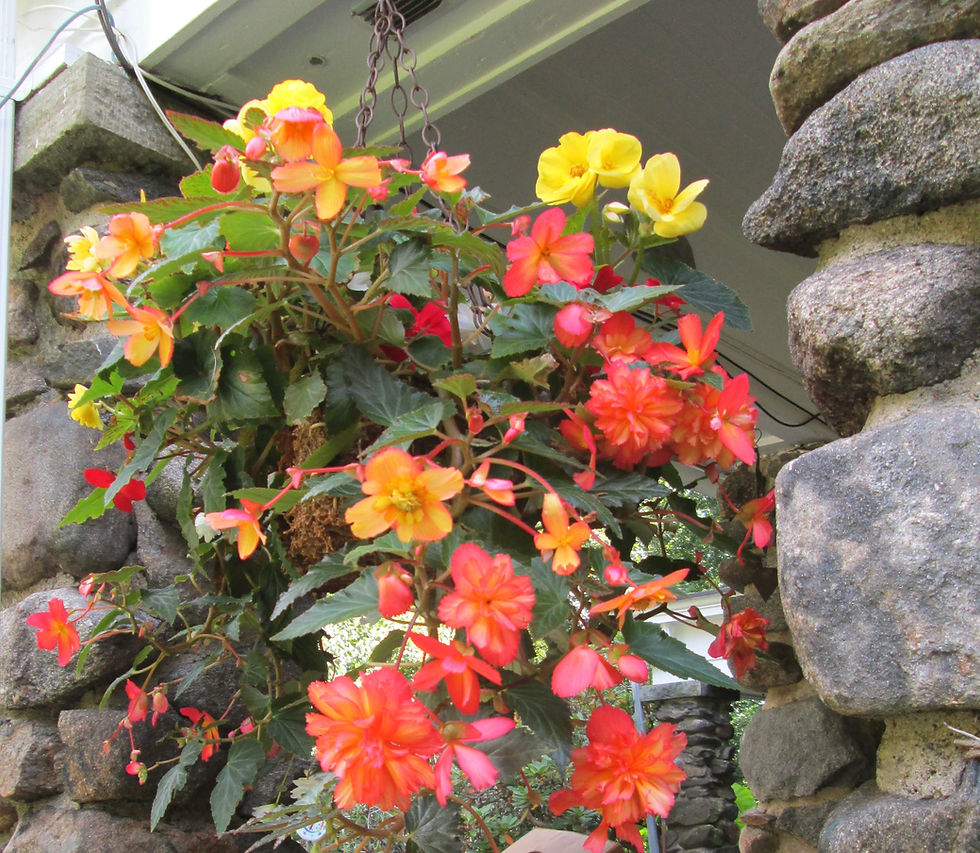
We’ve received our first load of nursery stock for the Side Yard and it looks great! We’re on our way to being fully stocked with hanging baskets, fruit trees and shrubs, herbs, perennial color and so much more. Warm weather crops will come in after Mother’s Day and then we’ll all be happy! The fruit trees have all received their first dose of foliar microbes since they arrived just before our frost threat last week (and we’re not done with the cold weather yet – beware!)
And – then there’s MOTHER’S DAY WEEKEND – May 10th! You have to check out our gift tables that are highlighting our local crafting vendors as well as a very nice mix of colorful accent pieces for all tastes (and tastes include honey, maple syrup, Hoppy Pop popcorn and Blue Darner’s granola and pancake mixes – all true taste delights!).
One last thought before we head into the May’s craziness: some of you are really interested in bees – and pollinators writ large. We have a bee class coming up this Saturday, May 2nd at 10:00am. Donna – one of our front desk staff – has managed bees for years and is going to walk people through the basics of getting hives started and stabilized. We also have a catch hive attached to one of the trees at the back of the side yard nursery to hopefully catch a swarm sometime this summer. Give the store a call to sign up – 978-632-0991.
And last but TOTALLY not least!!!!
A quick reminder about the upcoming workshop with Dan Kittredge (from the Bionutrient Institute - https://www.bionutrientinstitute.org) about nutrient density in the food supply – one of my absolute favorite topics because the information can be expanded and used in so very many ways. Dan will be presenting fascinating information on the research that’s been done into the variations in quality in our food supply. This is a HUGE step! Everyone seems to intuitively know that there are differences in the food supply but it’s been incredibly difficult (and expensive!!) to prove it. And – NO ONE FARMING MODEL WINS THE BLUE RIBBON FOR QUALITY!!!! That’s the most interesting part of the conversation from my perspective because it ties into everything that we all THINK we know about land, healthy systems, healthy plants and healthy animals (us!!)
This is also a chance to get conversations started throughout our region on what it takes to manage productive land in North Central Massachusetts – specifically - in the Northern Worcester Hills. Together, we can all grow stronger – and grow better quality food, fiber and forage – the products we produce best. :)
Come for the information. Come for the conversation. Come to bring changes to your farms, gardens and your community.
Here are the particulars: May 3rd, 2:30-4:30pm, at the Westminster Senior Center, 69 West Main St, Westminster, MA and it’s free!
Hope to see you there!


Comments